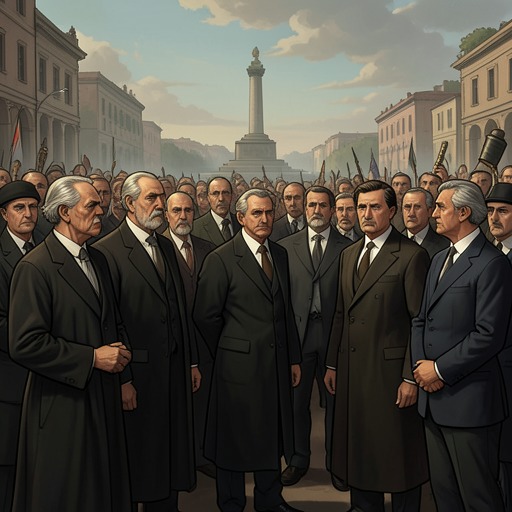
Mr. Spenlow
David CopperfieldMr. Spenlow is a proctor at Doctors' Commons, a carefully groomed professional, and the widowed father of Dora Spenlow. He gives David Copperfield his first route into the legal profession and, by welcoming him into his family circle, becomes the connection through which David meets Dora. His polished manners and appeals to the authority of his partner, Mr. Jorkins, make him both a courteous patron and a representative of a business culture in which personal generosity is continually measured against fees, agreements, and precedent.
Identity and Professional World
Mr. Spenlow is a partner in Spenlow and Jorkins, a firm at Doctors' Commons. The institution handles ecclesiastical law, including business concerning wills and marriages, as well as disputes involving ships. Its offices and courtrooms give David a first view of an old, specialized legal system: the firm’s rooms are reached through a low archway and narrow lanes, and its desks are crowded with bundles of allegations and libels and substantial collections of affidavit evidence. Mr. Spenlow arrives from the Court of Arches in a black gown trimmed with white fur, bringing the formal authority of the court into the office where he recruits David.
David’s initial impression is shaped by appearance as much as by office. Mr. Spenlow is a small, light-haired gentleman, tightly dressed in a stiff white cravat and carefully curled whiskers, with a massive gold watch-chain. His clothes and grooming suggest painstaking respectability. Even his movements seem governed by this formality: when he turns to look at papers after sitting down, he pivots his body almost as a single piece. The portrait is comic, but it also establishes how completely professional presentation forms part of his identity.
The legal world around him is shown as ceremonious and slow-moving. When he takes David into court, the advocates sit in black gowns trimmed with white fur, while the doctors preside in red gowns and grey wigs. A speaker proceeds through a vast body of evidence in a room whose quiet is broken only by the fire and the measured argument. The scene gives substance to the professional life Mr. Spenlow offers David: it is not merely an abstract career, but work within an elaborate institution of documents, specialized procedures, and courtly display.
David’s Apprenticeship and the Firm
Betsey Trotwood approaches Mr. Spenlow seeking a respectable provision for her nephew, and he tells her that the firm has a vacancy. When David visits the office, Mr. Spenlow asks whether he is considering the profession and explains the arrangement. He proposes an initial month of probation, saying that he himself would be willing to allow two or three months, or even an indefinite period, but that he has a partner. The required premium, including the stamp, is one thousand pounds. Mr. Spenlow presents the sum as a demand imposed by Mr. Jorkins rather than as his own preference.
David is unsettled by the apparent severity of this partner, but later discovers that Mr. Jorkins is mild and heavy-tempered. In the firm’s familiar account of itself, Jorkins carries the blame for decisions that Mr. Spenlow finds uncomfortable: he supposedly blocks salary increases and insists on collecting clients’ bills, while Mr. Spenlow appears as the sympathetic man whose hands would otherwise be open. The older David recognizes the arrangement as a recurring business tactic, not simply an eccentricity of this one office. Mr. Spenlow’s courteous manner therefore has a structural counterpart: he can offer warmth while attributing hard financial terms to someone else.
David is permitted to begin probation when he chooses, and the formal articles can be sent to Betsey for signature. Mr. Spenlow then takes him into court so he can see the profession at work. Once David is articled, the occasion is marked modestly: he brings sandwiches and sherry for the clerks and goes to the theatre alone that night. Mr. Spenlow later follows through on his promise to entertain him at his home, inviting him to stay from Saturday until Monday and driving him there and back in his phaeton. These steps turn a professional arrangement into a personal introduction to the Spenlow household.
Father of Dora and David’s Social Introduction
Mr. Spenlow is a widower with one daughter, Dora, who is expected home after completing her education in Paris. He tells David that he hopes to entertain him when she returns. The invitation makes Mr. Spenlow the immediate link between David’s new working life and the romance that follows: David first enters the family’s social world through the hospitality of his employer.
That hospitality becomes more pointed when Mr. Spenlow tells David that Dora’s birthday is approaching and invites him to join a small picnic. David reacts with extravagant preparation. He buys an elaborate cravat, sends a hamper containing crackers with romantic mottoes, gets up early to choose a bouquet at Covent Garden Market, and rides to Norwood where David and Dora courted on a hired horse. His self-conscious attempts to appear casual as he approaches the house underline how much the invitation matters to him. Mr. Spenlow does not engineer David’s feelings, but his welcome places David in Dora’s company and helps transform an employer’s household into the setting of David’s courtship.
Mr. Spenlow’s role also touches ordinary legal and family business. After Mr. Barkis dies, David takes charge of Peggotty’s affairs, proves the will, and settles the legacy duty. When David brings Peggotty to the office to pay the bill for this common-form probate work, Mr. Spenlow is away arranging for a man to swear an affidavit for a marriage licence. The scene places probate and marriage in the same everyday professional orbit: bereavement, inheritance, and new unions arrive at the office as matters of procedure and payment.
Limits of Benevolence and Narrative Role
After Betsey loses her money, David asks Mr. Spenlow whether his articles can be cancelled because he does not know how he will support himself and must earn his living. He emphasizes that he is not giving up hope for the future, but that his immediate circumstances have changed. Mr. Spenlow expresses sympathy, then explains that cancelling articles for this reason is not customary or professionally convenient. He again begins to distinguish what he might do personally from what he can do while bound by his partner’s position. The exchange brings the limits of his earlier patronage into view: David’s entry into the profession depended on substantial means, and his own hardship cannot readily be accommodated by the formal agreement.
Mr. Spenlow is not presented as openly hostile to David. He is courteous, fulfills his invitation, and expresses regret when David’s circumstances deteriorate. Yet the same voice that offers welcome also administers a costly apprenticeship and upholds rules that do not bend easily to need. His recurring reliance on Mr. Jorkins allows him to appear personally generous while the firm remains financially exacting. Through this contrast, Mr. Spenlow connects David’s private hopes—to make a career, to enter Dora’s family, and to imagine a future with her—to the institutional and economic conditions governing access to professional life.